
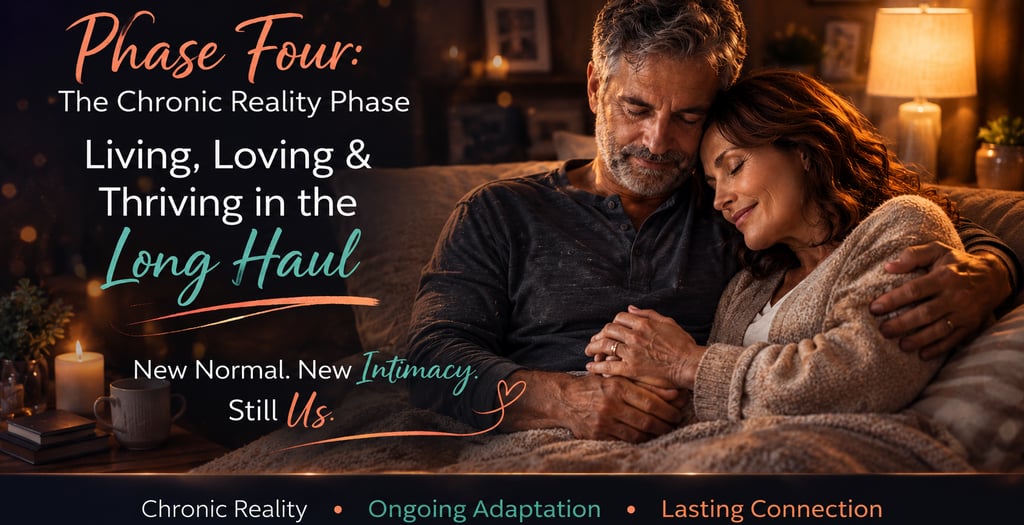
Phase Four: The Chronic Reality Phase Learning How to Love, Desire, and Connect in the Long Haul
What happens when chronic illness stops being a temporary battle and becomes part of everyday life? This heartfelt, humorous, and deeply therapeutic blog explores Phase Four of the illness trajectory—the chronic reality phase—where survivorship, adaptation, and long-term intimacy take center stage. From navigating ongoing fatigue, pain, and changing sexual abilities to discovering new ways of connecting physically and emotionally, this piece compassionately unpacks how couples learn to redefine pleasure, confidence, and closeness over time. If you’ve ever wondered how relationships survive the long haul of chronic illness—and often emerge stronger, more honest, and more deeply connected—this blog offers reassurance, practical insight, and a powerful reminder that intimacy is not about perfection, but presence.
PHYSICAL HEALTH AND SEXBODY IMAGE AND SEXGENERAL SEXUAL HEALTH
Dr. R. Kent
5/22/20266 min read
There’s a subtle but profound transition that happens after Phase Three. Phase Three is about becoming. It’s emotional, reflective, identity-centered. It’s the realization that illness has changed you and your relationship in meaningful ways.
Phase Four is what happens after the realization settles in. This is the chronic reality phase. This is the stage where the routines become familiar, the medications become part of the nightstand décor, and your body’s unpredictability starts feeling less like a surprise and more like an inconvenient roommate who refuses to contribute financially. And here’s the truth many couples quietly wrestle with: Phase Four is often not about “getting better.”
It’s about learning how to live.
For some people, this phase may involve remission or stabilization. For others, it’s about survivorship. Ongoing management. Persistent symptoms. A body that may improve in some areas while remaining permanently changed in others. The fantasy many people carry into illness is that eventually there will be a finish line. A moment where life returns to exactly how it used to be. Phase Four gently—and sometimes painfully—teaches that chronic reality often doesn’t work that way. You may not return to the old version of yourself. But that does not mean your life, your relationship, or your sexuality are over. It means they are evolving into something more sustainable.
The Shift from “Fighting” to Living
In earlier phases, the emotional energy often centers around survival and treatment. You are “fighting.” “Battling.” “Pushing through.” Phase Four is different. You wake up one morning and realize you cannot spend every day emotionally preparing for war. At some point, life has to become life again. This transition can feel emotionally complicated. For the person living with chronic illness, there may be grief in acknowledging permanence. Even if symptoms are manageable, there can be sadness in realizing your body may never function exactly the same way again. There may also be relief. Relief that the constant panic has softened. Relief that you know your body better now. Relief that not every symptom sends you into a spiral of catastrophic Googling at 1:00 a.m. The chronic reality phase is less dramatic, but often more emotionally honest. You stop asking, “How do I get my old life back?” and begin asking, “How do I build a meaningful life from here?” That question changes everything—including intimacy.
The Survivor Identity
Many people in Phase Four begin identifying less as patients and more as survivors or long-term fighters. That identity carries complexity. On one hand, there is pride. You have endured. You have adapted. You have survived things that once felt impossible. On the other hand, there can be exhaustion. Because survivorship is not always glamorous. Sometimes it’s just remembering medications, managing fatigue, attending follow-ups, and trying to maintain enough energy to feel like a human being instead of a walking medical chart. The body may still hurt. Libido may still fluctuate. Fatigue may still interrupt plans. Symptoms may still appear without warning. The difference is that now you know this is part of the landscape. And once you stop waiting for the perfect version of your body to return, you can begin learning how to experience pleasure inside the body you have now. That shift is deeply therapeutic.
The Emotional Reality for the Person Living with Illness
By Phase Four, many people feel emotionally split between acceptance and frustration. You may feel stronger emotionally than ever before while simultaneously feeling physically limited in ways that still sting. There are moments of confidence. Moments where you think, I’ve adapted well.
And then there are moments where your body refuses to cooperate and you think, I am so tired of managing this.
Sexuality in this stage often reflects that emotional duality. You may genuinely want intimacy while also needing to negotiate around pain, stiffness, fatigue, or medication timing. You may feel more emotionally open than before illness while simultaneously feeling less physically spontaneous. There can also be moments of insecurity. Even after years together, you may still wonder if your partner misses the old version of you. You may question whether your body is “enough” in its current state. And yet, there is often a new level of emotional honesty in this phase. You’ve been through too much together for superficial communication to survive.
You know how to say, “Today is a hard body day.”
You know how to say, “I want closeness, but I need to pace myself.”
That honesty becomes part of intimacy itself.
The Emotional Reality for the Partner
Partners in Phase Four often experience their own evolution. The initial fear has usually softened into awareness. They understand the rhythms of the illness now. They know what fatigue looks like before you say a word. They recognize flare days. They anticipate limitations. But they also carry emotional fatigue of their own.
Long-term caregiving—even subtle caregiving—can be draining. Partners may feel guilty admitting that. They may struggle with balancing empathy and personal needs. At the same time, many partners describe feeling emotionally closer than ever before. Because surviving chronic illness together requires vulnerability, teamwork, and communication in ways many couples never experience. The relationship has been tested. And it’s still standing.
That creates a kind of intimacy that goes beyond attraction alone. Partners often begin seeing each other differently—not less romantically, but more deeply. There’s admiration now. Respect. A sense of, We’ve carried each other through difficult things. That emotional connection can become profoundly erotic in its own right.
The Reality of Long-Term Sexual Adaptation
This is where Phase Four becomes practical. Because chronic reality often means learning how to adapt sex rather than abandon it. And adaptation is not failure. Let’s say that louder for the people in the back holding heating pads and muscle relaxers: Adaptation is not failure.
Bodies change throughout life regardless of illness. Chronic illness simply accelerates the need for creativity. This phase often involves rethinking what intimacy looks like physically. Positions may need modification to reduce pain or conserve energy. Couples may experiment with side-lying positions, supportive pillows, slower pacing, or shorter encounters. Some learn that morning intimacy works better than nighttime fatigue. Others discover that planning intimacy is actually helpful—not unromantic.
There may be more emphasis on touch, oral intimacy, massage, mutual stimulation, or sensual closeness rather than rigid expectations around penetration or orgasm. And honestly? Many couples discover this broadens their sexual relationship in unexpectedly positive ways. Because when sex stops being defined by a single script, couples become more attentive to pleasure itself. “What feels good?” becomes more important than “Are we doing this the normal way?” That question is liberating.
The Humor of Chronic Intimacy
By Phase Four, humor often returns in full force. You have to laugh sometimes. You laugh because one of you threw out your back trying to be seductive. You laugh because intimacy now occasionally requires stretching, hydration, and strategic pillow placement like you’re preparing for a mildly athletic camping trip. You laugh because there’s something absurdly human about saying, “Hold on, my hip disagrees with this position.” Humor reduces shame. It reminds couples that sex does not have to be flawless to be meaningful. In fact, many long-term couples become more playful precisely because perfection stopped being the goal years ago.
Redefining Pleasure
One of the most therapeutic shifts in Phase Four is redefining pleasure itself. Pleasure becomes less performance-based and more experiential. It’s not about proving your body still works the same way. It’s about discovering what connection feels like now. Sometimes pleasure is intense and passionate. Sometimes it’s slow and deeply comforting. Sometimes it’s simply lying together skin-to-skin after a difficult week and remembering you still belong to each other. And yes, there may be periods where sex is scarce again. Chronic illness tends to ebb and flow. But scarcity no longer automatically means crisis. You’ve learned resilience by now. You know intimacy can pause and return. You know connection can survive fluctuation.
The Relationship That Emerges
By the time couples reach Phase Four, their relationship often looks different than it once did. Not weaker; different. There is usually more intentionality. More honesty. More flexibility. More compassion.
You have learned how to love each other inside reality rather than fantasy. You have seen each other at your most vulnerable and stayed. That changes a relationship permanently.
And strangely enough, many couples report feeling more emotionally and sexually connected in this phase than they did before illness—not because illness is romantic, but because surviving together stripped away so much pretense. You stop chasing perfection. You start choosing presence.
Phase Four is not the triumphant movie ending where everything magically returns to normal. It is something quieter and more profound. It is learning how to build intimacy inside chronic reality. It is discovering that pleasure still exists even when bodies are imperfect. It is realizing that connection can deepen through adaptation rather than disappear because of it. You may always carry parts of the illness with you. But you also carry resilience. Experience. Creativity. Humor. Love.
And in Phase Four, those things become the foundation of intimacy itself and the foundation will allow you to let the Afterglow begin.

Connect with us
© 2026. All rights reserved.
Address: 5294 Madison Pike, Suite 202 Independence, KY 41051
Email: dr.kent@afterglowhealth.org
Phone: (859) 955-8852 (secure text or talk)